
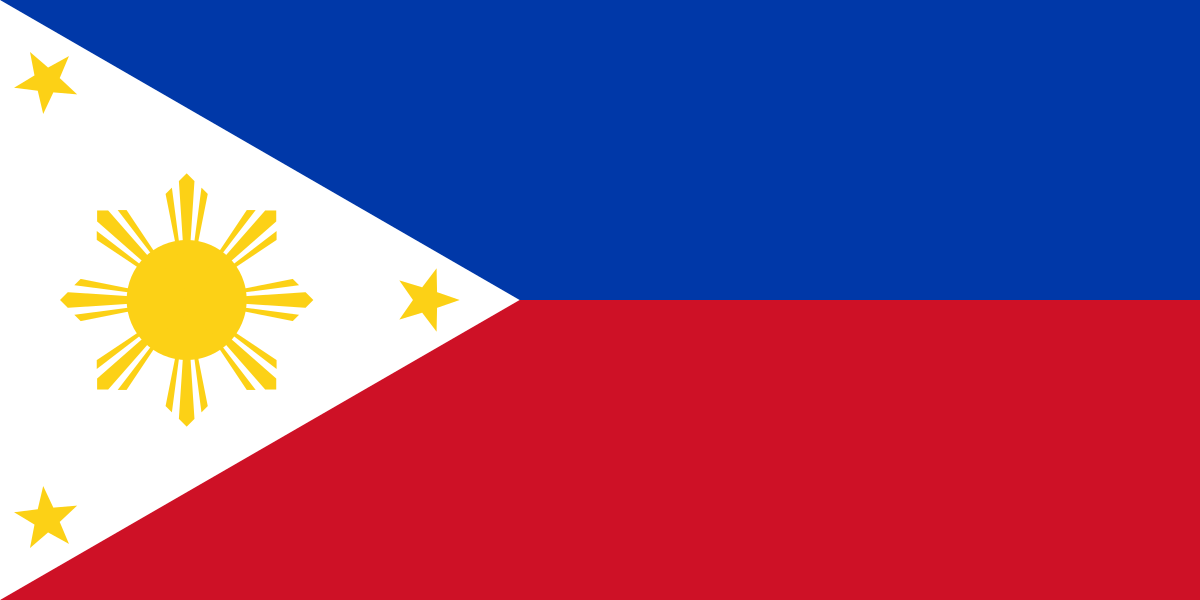
Contents
Overview
The geological genesis of the Philippine Islands is a dramatic tale of tectonic collision, a process that began millions of years ago. As the Philippine Sea Plate subducts beneath the Eurasian Plate, volcanic activity and mountain-building forged this sprawling archipelago. Early human inhabitants, the Negritos, arrived via land bridges or primitive seafaring, followed by successive waves of Austronesian peoples who brought with them advanced maritime technology and agricultural practices. The islands' strategic location in maritime Southeast Asia made them a nexus for trade and cultural exchange with China, India, and the Arab world, long before European arrival. The Spanish colonial era, beginning with Ferdinand Magellan's arrival in 1521 and solidified by Miguel López de Legazpi's expedition in 1565, fundamentally altered the islands' trajectory, introducing Christianity and a centralized administration that, for the first time, attempted to unify the disparate islands under a single political entity. This period laid the groundwork for the modern Republic of the Philippines, though the legacy of division and regional identity persisted.
⚙️ Geographical Divisions
The Philippine archipelago is conventionally segmented into three primary geographical divisions: Luzon, Visayas, and Mindanao. Luzon, the largest and most populous island, is home to the nation's capital, Manila, and is characterized by its mountain ranges, fertile plains, and significant volcanic activity, including Mount Mayon. The Visayas, a cluster of central islands like Cebu, Panay, and Samar, are known for their stunning beaches, rich marine biodiversity, and a history deeply intertwined with maritime trade and early Filipino kingdoms. Mindanao, the second-largest island, is a land of diverse landscapes, from the mountainous interior to coastal plains, and is home to a significant indigenous population and a distinct cultural heritage, including the Moro communities. Each division possesses unique ecological features, cultural nuances, and economic drivers, contributing to the nation's complex mosaic.
📊 Key Facts & Numbers
The Philippine Islands boast a staggering scale, with approximately 7,641 islands covering a total land area of roughly 300,000 square kilometers. This vast archipelago is home to over 114 million people, making it the world's twelfth-most populous country as of recent estimates. The nation's maritime territory extends significantly, with an exclusive economic zone covering approximately 2.2 million square kilometers. The islands are distributed across a wide latitude, from Batanes in the north to Tawi-Tawi in the south, experiencing diverse climatic conditions ranging from tropical rainforests to more temperate highland regions. The country's population density is high, particularly in urban centers like Metro Manila, which houses over 13 million people. The economic output of the Philippines, measured by its GDP, stands at over $400 billion USD annually, with a significant portion derived from services, industry, and agriculture spread across its varied islands.
👥 Key People & Organizations
While no single individual can claim dominion over the entire archipelago, figures like Ferdinand Magellan, whose 1521 voyage marked the first European contact, and Miguel López de Legazpi, who established the first Spanish settlement in 1565, are pivotal in its recorded history. Later, national heroes such as Jose Rizal, a key figure in the Philippine Revolution, and Andres Bonifacio, founder of the Katipunan, galvanized movements for independence. In the modern era, presidents like Corazon Aquino, who led the People Power Revolution in 1986, and Rodrigo Duterte, whose presidency saw significant policy shifts, have shaped the nation's governance. Organizations like the National Historical Commission of the Philippines work to preserve the islands' heritage, while entities such as the Department of Tourism promote its attractions. The Philippine Coast Guard and Philippine Navy are crucial for managing the vast maritime domain.
🌍 Cultural Impact & Influence
The insular nature of the Philippine Islands has fostered an extraordinary diversity of cultures, languages, and traditions. With over 170 distinct languages spoken, including Tagalog, Cebuano, and Ilocano, the archipelago is a linguistic marvel. This diversity is reflected in its cuisine, which features regional specialties like Bicol Express in the Bicol region and Kinilaw in the Visayas, heavily influenced by indigenous ingredients and historical trade. The islands are also renowned for their vibrant festivals, such as the Ati-Atihan Festival in Aklan and the Sinulog Festival in Cebu, which blend indigenous rituals with Catholic traditions. The archipelago's natural beauty, from the Chocolate Hills in Bohol to the Palawan's underground river, has also made it a significant destination for eco-tourism and a source of national pride, impacting the global perception of Filipino identity through media and travel.
⚡ Current State & Latest Developments
In recent years, the Philippine Islands have faced significant challenges and opportunities, particularly concerning environmental sustainability and maritime security. The nation is actively engaged in managing the impacts of climate change, including rising sea levels and more frequent typhoons, which disproportionately affect its low-lying islands. Geopolitically, the West Philippine Sea dispute with China remains a critical issue, leading to increased maritime patrols by the Philippine Coast Guard and diplomatic engagements with allies like the United States. Economically, the country continues to leverage its strategic location for trade and investment, with ongoing infrastructure projects aimed at improving connectivity between islands. The digital landscape is also rapidly evolving, with increasing internet penetration and the growth of the tech industry in urban centers like Taguig City.
🤔 Controversies & Debates
The very existence of the Philippine Islands as a single political entity is a subject of ongoing debate, particularly concerning the historical unification efforts and the persistent regional identities. The vastness of the archipelago and the sheer number of islands present immense logistical and governance challenges, leading to discussions about decentralization and regional autonomy. Environmental concerns, such as the impact of large-scale mining operations on islands like Mindoro and the protection of marine ecosystems from overfishing and pollution, are also highly contested. Furthermore, the territorial disputes in the South China Sea create significant geopolitical tensions, with differing interpretations of international law and historical claims fueling ongoing diplomatic and military posturing between the Philippines and China. The management of natural resources across such a diverse island chain also sparks debate regarding equitable distribution and sustainable practices.
🔮 Future Outlook & Predictions
The future of the Philippine Islands is intrinsically linked to its ability to navigate environmental challenges and leverage its strategic position. Experts predict continued investment in renewable energy sources, such as offshore wind and solar power, to mitigate the impacts of climate change and reduce reliance on imported fossil fuels. The development of inter-island transportation infrastructure, including high-speed ferries and potentially new airports, is crucial for economic growth and national integration. Geopolitically, the Philippines is likely to continue strengthening its alliances with countries like Japan and Australia to bolster its maritime security in the face of regional tensions. The nation's burgeoning creative economy, particularly in areas like film and digital content, is also poised for significant growth, further diversifying its economic base beyond traditional industries. The ongoing demographic shifts, with a young and growing population, will also shape future labor markets and social policies.
💡 Practical Applications
The Philippine Islands serve as a critical hub for maritime trade and logistics in the Asia-Pacific region, with major ports like Port of Manila and Port of Batangas handling substantial cargo volumes. Th
Key Facts
- Category
- travel
- Type
- topic